Background: The Stellantis Portugal Transfer Pricing Arrangement
GMP operated as a Portuguese distributor for vehicles, purchasing these from related OEMs established in other EU Member States and reselling them to independent dealers. Under the group’s pricing agreement, the initial transfer price charged by the OEMs was determined using an initial pricing mechanism. The calculation started with the expected external selling price and deducted the relevant distribution costs and GMP’s predetermined profit margin. At the end of each reference period, the OEMs adjusted that initial selling price upwards or downwards, through debit or credit notes, so that GMP achieved the agreed operating profit margin.
The VAT Question Before the CJEU
The Portuguese tax authorities argued that the adjustments to the initial selling price represented remuneration for repair-related services purportedly supplied by the distributor to the manufacturers. In their view, because repair costs formed part of the adjustment calculation, the adjustment should be regarded as payment for services and therefore fall within the scope of VAT, albeit as a supply separate from the supply of the vehicles.
The Court was asked to determine whether a transfer pricing adjustment that is:
- provided for in an intra-group agreement designed to ensure that a distributor achieved a predetermined profit margin;
- documented through credit and debit notes issued between related parties; and
- calculated taking into account a range of costs, including warranty and repair costs, could constitute consideration for a supply of services for VAT purposes.
CJEU Decision: Transfer Pricing Adjustment Was Not Consideration for Services
The Court held that, for VAT to apply, there must be a direct link between an identifiable service supplied and the remuneration received. It noted that the transfer pricing agreement at issue was primarily intended to ensure that the distributor achieved a predetermined profit margin and not to remunerate repair services.
Crucially, the Court found no evidence of a legal relationship under which the distributor was contractually obliged to provide repair services to the manufacturers in exchange for the transfer pricing adjustment. The fact that repair costs were included among the factors used to calculate the adjustment was not sufficient, in itself, to establish such a link.
The Court also observed that the adjustment was calculated by reference to GMP’s overall distribution costs, and not solely by reference to repair costs. Depending on GMP’s overall financial result, the mechanism could give rise not only to credit notes but also to debit notes, the latter in particular indicating that GMP was therefore not necessarily reimbursed for its repair costs, and any link between the alleged repair services and the adjustment was, at most, indirect.
The CJEU’s Core Reasoning [1]
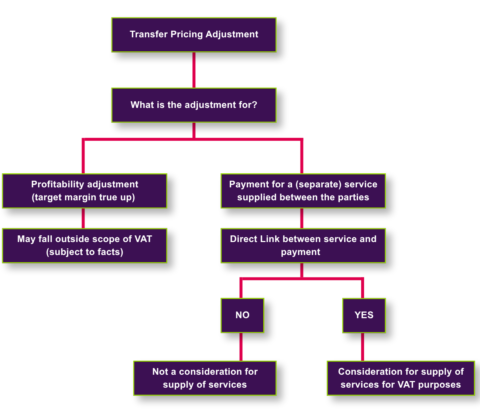
The Court therefore concluded in the given case that a transfer pricing adjustment of this nature does not constitute consideration for a supply of services merely because it is evidenced through credit or debit notes and calculated by reference to costs that include warranty or repair expenses.
However, the Court also made clear that a different conclusion could be reached where there is a legal relationship characterised by reciprocal obligations, under which one party supplies services to the other and the adjustment constitutes remuneration directly linked to those services.
In addition, the Court observed that where an adjustment is not remuneration for services but instead represents a revision of the price originally charged for the goods supplied, the VAT consequences should be analysed under the rules governing adjustments to the taxable amount.
What Does the Stellantis Judgment Mean for Transfer Pricing and VAT?
This judgment confirms that transfer pricing adjustments do not automatically create a VAT liability. Its treatment depends on the legal and economic nature of the underlying arrangement and whether the adjustment can be linked to an identifiable supply.
Stellantis vs Arcomet: Different VAT Outcomes
This can be seen by comparing Stellantis with the Court’s earlier decision in Arcomet Towercranes (Case C 726/23). In Arcomet, a profit-based adjustment was treated as consideration for services because the underlying agreement identified the services being provided, established reciprocal obligations between the parties and created a direct link between those services and the payment. In Stellantis, by contrast, the agreement governed the OEM to distributor vehicle pricing mechanism and did not establish an obligation for the distributor to provide repair services to the OEMs.
When Can a Transfer Pricing Adjustment Be Relevant for VAT?
Taken together, the two judgments indicate that a transfer pricing adjustment may be relevant for VAT purposes principally in two situations:
- where the adjustment is payment for services provided between the parties; or
- where the adjustment changes the price of an earlier transaction, requiring the VAT taxable amount to be adjusted.
In all other cases, transfer pricing adjustments should generally fall outside the scope of VAT.
That said, there is no one-size-fits-all rule. The VAT treatment will always depend on the specific facts and circumstances, including the intercompany agreements, TP documentation, invoices, calculation workings, conduct of the parties and evidence of the activities actually undertaken. In the Stellantis case, the CJEU placed significant emphasis on the wording of the intra-group agreement. The absence of any contractual obligation to provide services in exchange for remuneration was a key factor in the Court’s conclusion that the adjustment was not consideration for repair services.
Key Considerations for Multinational Groups
Careful drafting of intra-group agreements and transfer pricing policies is essential. The agreements, TP documentation, invoicing and actual conduct of the parties should consistently reflect the legal and economic nature of the underlying arrangements.
Impact and Next Steps
The way these arrangements are documented, and the purpose of any transfer pricing adjustments, can play a crucial role in determining their VAT treatment and in managing potential challenges from the tax authorities.
In the case of parties with less than full VAT recovery, the outcome of any adjustment subject to VAT is expected to have an impact on costs for the business. For all businesses, any adjustment treated as the supply of a service or an adjustment to the amount charged on a previous supply, will give rise to VAT invoicing and reporting actions, potentially impacting on amounts previously reported.
Overall, there are points to be considered in relation to any TP related adjustment, the outcome of which will feed into the VAT related reporting and associated matters to then be dealt with.
At RBK, we can assist you in relation to Transfer Pricing and VAT related matters relevant to your business. If you are looking at a transaction or considering an adjustment to the amounts charged on or related to previous transactions, please don’t hesitate to speak with your usual RBK contact or our dedicated Transfer Pricing or VAT experts.
Disclaimer: While every effort has been made to ensure the accuracy of information within this publication is correct at the time of going to print, RBK do not accept any responsibility for any errors, omissions or misinformation whatsoever in this publication and shall have no liability whatsoever. The information contained in this publication is not intended to be advice on any particular matter. No reader should act on the basis of any matter contained in this publication without appropriate professional advice.
[1] – In case of profitability adjustments, VAT outcome depends on whether the adjustment changes the taxable amount of underlying supply