
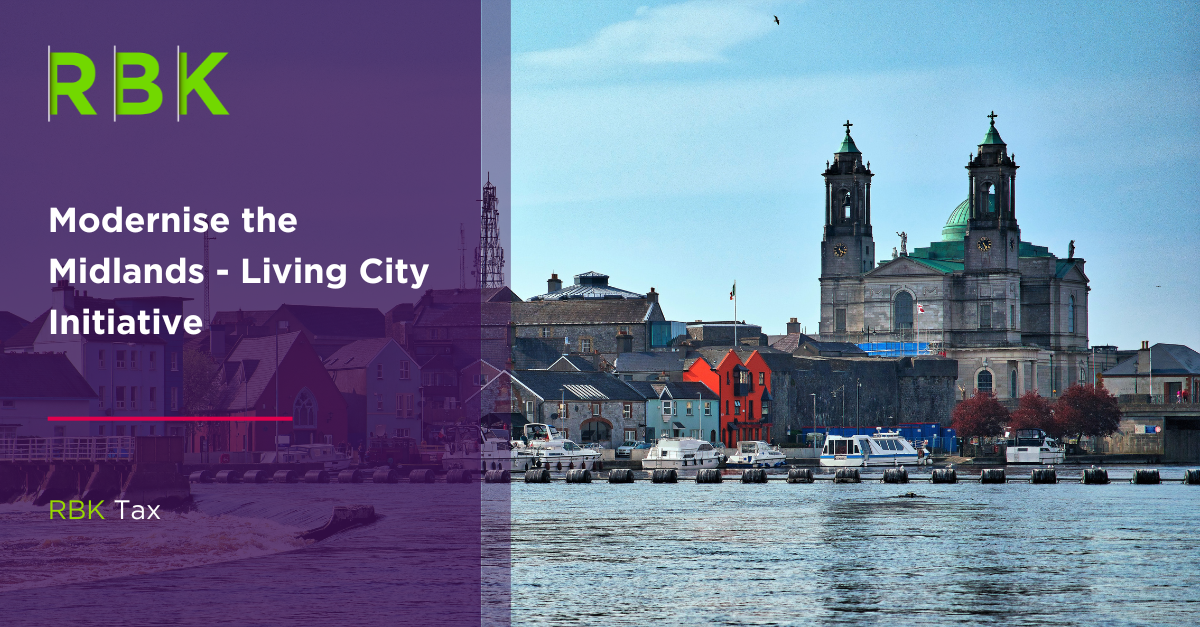
On 17 April 2026, the Tánaiste and Minister for Finance, Simon Harris signed a number of Statutory Instruments to formally designate five additional towns, one of which is Athlone as “Special Regeneration Areas”, under the Living City Initiative (LCI).
The relevant local authorities of each town have prepared Special Regeneration Area (SRA) maps, which designate the areas to which the initiative will apply. The link to the SRA maps can be found here: https://www.gov.ie/en/department-of-finance/publications/living-city-initiative-special-regeneration-area-maps/
Alongside the inclusion of the new towns into the initiative, a number of other benefits were also introduced. The headline benefits being the extension of the scheme to 2030, the change of the building age requirement from pre-1915 to pre-1975, the introduction of the ‘Living Over the Shop Relief’ and the increase to a maximum €300,000 tax relief over a 3 year-rolling period compared to the previous limit of €200,000.
What is the Living City Initiative?
The Living City Initiative is a targeted tax incentive scheme to promote the refurbishment and regeneration of historical urban properties. The incentive scheme provides relief for both owner-occupiers and landlords. There are four types of relief available under this scheme:
- owner occupier residential relief,
- rented residential (landlord) relief,
- commercial relief, and
- living over the shop relief.
How can I benefit from the Living City Initiative?
The LCI offers relief from income tax or corporation tax for qualifying expenditure on the refurbishment and/or conversion of buildings located in Athlone, and any other locations included as “Special Regeneration Areas” within the LCI (for example Drogheda, Dundalk, Letterkenny etc.).
Owner Occupier Relief
This relief is specific to individuals and only available to claimants who occupy the property as their sole or main residence. However, a property developer may carry out the refurbishment or conversion work under this scheme and then sell the refurbished or converted property to an individual who can then claim the relief.
Where an individual spends at least €5,000 on the refurbishment or conversion of a building - provided the building was built before 1975 - they are entitled to tax relief by way of a deduction from their total income.
The individual’s total income is reduced by an amount equal to 15% of the qualifying expenditure being allowed as a deduction in each of the first six years and 10% allowed as a deduction in year seven. Where the deduction on such expenditure is not fully utilised in the year, the unused portion of the deduction may be carried forward to the next year and so on for a period of ten years from the year of assessment in which a claim was first made.
Rented Residential Relief/Commercial Relief/Living Over The Shop Relief
Unlike the ‘Owner Occupier Relief’ these reliefs can be claimed by an individual, company or body of persons who spends at least €5,000 on the refurbishment or conversion of a building and where no capital allowances are being claimed on the building. The claimant is entitled to tax relief by way of accelerated capital allowances. The maximum amount of tax relief you can claim is €300,000 over a 3-year rolling period.
The accelerated capital allowances allow the claimant to receive a deduction of 50% per year over a two-year period for the qualifying expenditure. Where the relief cannot be fully utilized in a particular year the unused portion of the relief may be carried forward by the claimant to the next year and so on for a period of ten years.
However, each relief targets specific usage of the premises post-refurbishment and as such, the conditions are slightly different for each:
Rented Residential Relief: This relief is available where after the completion of the conversion or refurbishment works, the premises must be let for use as a residential premises. Additionally, the premises must have been built prior to 1975.
Commercial relief: This relief is available where after the completion of the conversion or refurbishment works, the premises must be used for retail purposes or for the provision of services. There is no pre-age building requirement for this relief.
Living Over the Shop Relief: This relief is available where before the conversion or refurbishment of the premises into one or more houses, the premises must be subject to commercial rates (i.e. in most cases a commercial or industrial premises) and after the qualifying expenditure is incurred on its conversion or refurbishment, the premises must be a property which isn’t subject to commercial rates. Additionally, after the conversion or refurbishment of the premises into one or more houses, the house or houses concerned must be let for use as a residential premises. There is no pre-age building requirement for this relief.
How do I claim the relief under the Living City Initiative?
Where you qualify for any of the reliefs outlined above, claiming the relief will depend on whether your tax is paid under the PAYE system or the self-assessment system. Where you fall under the PAYE system, the claim can be made using Revenue’s online Form 12 , and where you fall under the self-assessment, the claim can be made on the applicable return associated to claimant (i.e. Form 11 for individual, Form CT1 for a company etc.).
Warnings
It is important to be aware that the relief only applies to direct costs of the refurbishment or conversion , so for instance, the cost of acquiring the property or building a new extension will not qualify for the relief . Additionally, any grant or assistance received relating to the works being carried out, must be deducted when calculating the relief available.
What steps can I take now to aid in claiming the relief?
Whether you have property, or looking to purchase a property, the starting point is to determine whether the property is contained within the relevant area qualifying for the relief.
If you are refurbishing or converting a property for residential use, it will be necessary to obtain a Letter of Certification from the relevant local authority. This is applied for before work begins on the property and will be issued once all works have been completed. The Letter of Certification will contain a reference number which will be required when making the claim for relief on your Income Tax return.
A Letter of Certification is not required for commercial property.
Contact Us
At RBK, we can assist you with any claims under the living city initiative. Please get in touch with your assigned tax engagement partner or either Claire Fitzgerald or Aaron McBride and we would be happy to discuss any queries further with you.
Disclaimer: While every effort has been made to ensure the accuracy of information within this publication is correct at the time of going to print, RBK do not accept any responsibility for any errors, omissions or misinformation whatsoever in this publication and shall have no liability whatsoever. The information contained in this publication is not intended to be advice on any particular matter. No reader should act on the basis of any matter contained in this publication without appropriate professional advice.